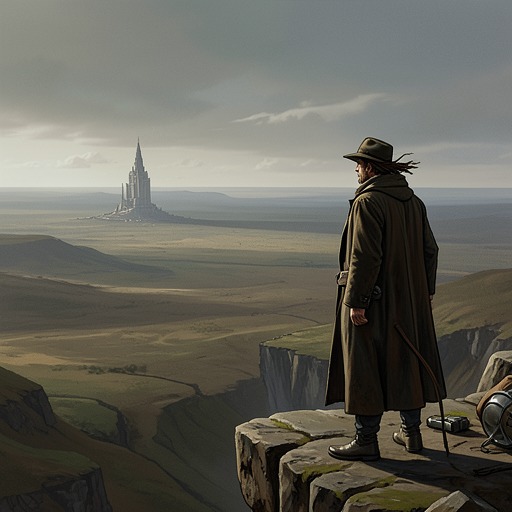
The Great Race plans to inhabit the future beetle race
The Colour Out of SpaceThe Great Race of Yith’s plan to inhabit the future beetle race is a strategy for collective survival: foreseeing a final catastrophe in its own age, it intends to send millions of minds forward through time into safer bodies. The plan makes the beetle civilization that follows humanity not merely a successor species, but the refuge chosen for the Great Race’s most capable minds.
A future secured by projection
In Nathaniel Wingate Peaslee’s dream-derived account, the future transfer is presented as knowledge gained through the Great Race’s projections across time. Those projections reveal that a final, successful irruption by the Elder Things will bring the Great Race’s age to ruin. The threatened migration is therefore not a speculative adventure or an ordinary change of civilization: it is a deliberate response to a catastrophe the Great Race believes it cannot withstand in its present world.
The danger is sharpened by what the Great Race understands about the Elder Things’ purpose. Their eventual return is expected to be an act of vengeance, not an effort to reclaim the surface world. Later races will pass through Earth without being troubled by them, suggesting that the Elder Things will not maintain an enduring dominion above ground. But that distant outcome offers little comfort to the Great Race, whose own extinction-level peril comes first.
The beetle bodies as refuge
The minds selected for the exodus are the Great Race’s keenest, and the projected transfer is on a vast scale: millions are to cross the gulf of time and inhabit members of the hardy coleopterous species that succeeds mankind. The beetles are thus both a future people in Earth’s succession and the bodies through which the Great Race expects its intellectual elite to survive. The plan does not describe a rescue of the Great Race’s existing bodies; its continuity depends on minds leaving them behind for another species’ forms.
The beetle age is also a limit, not an ultimate haven. Peaslee’s account places another migration later in Earth’s history, when the transferred minds are expected to move through time and space again, this time into the bodies of bulbous vegetable entities on Mercury. Other races will then cling to the cold Earth and burrow toward its horror-filled core before the planet reaches its end. The succession of bodies offers the Great Race a way to endure successive worlds, but not escape the eventual closing of Earth’s span.
Survival under the shadow of the Elder Things
The plan’s urgency follows from the long, uneasy history between the Great Race and the Elder Things. Sporadic incursions from the inner world had already led the Great Race to seal or guard passages into the depths, maintain weapons, and keep watch. Its fear was so deeply fixed that the Elder Things’ appearance was excluded from common speech and visible records. The projected final irruption gives that vigilance a terrible horizon: precautions may delay the danger, but the expected answer to it is flight across time.
The beetle migration therefore recasts the Great Race’s power. Its minds can explore other ages and prepare a future refuge, yet that reach does not amount to mastery over every threat. Faced with the Elder Things’ foretold return, the Great Race’s most consequential act is to preserve itself by becoming, in another age, something other than itself.